
Let’s start with something most brands won’t admit out loud.
Their marketing looks busy.
Ads are running.
Posts are going up.
Reports are being shared.
But revenue? That part feels… inconsistent.
The Illusion of Activity vs Real Growth
Welcome to the illusion of modern digital marketing – where activity is mistaken for progress.
Because here’s what’s actually happening behind the scenes:
- Campaigns are launched without a clear conversion path
- Traffic is driven to pages that were never designed to convert
- Data is collected, but rarely used to make decisions
- And strategy quietly takes a backseat to “let’s try this next”
It’s not that brands aren’t investing in digital marketing. They are. Aggressively.
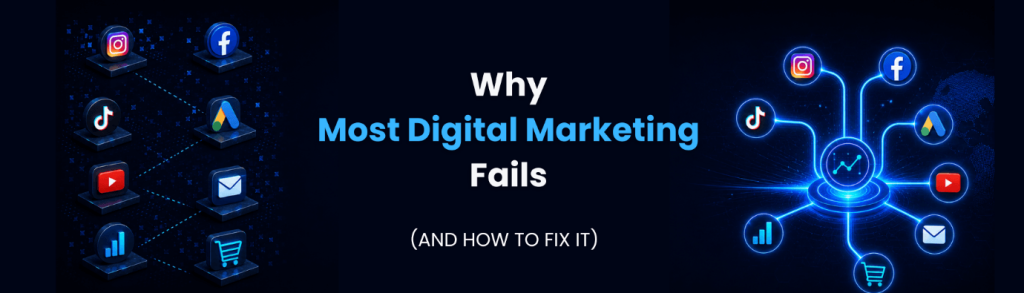
It’s just that most of that investment is happening in isolated efforts, not in a connected system.
And without a system, nothing compounds.
Money goes in. Effort goes up.
But growth? That remains unpredictable.
Because digital marketing today is not about running campaigns.
It’s about engineering a system where every click has somewhere to go, and every action leads to an outcome.
And that’s where most businesses fall short.
1. The Root Cause: Fragmentation (The Biggest Killer)
If you zoom out and map how most businesses run their digital marketing, it looks like a well-intentioned mess.
- One agency handles social media
- Another runs Google Ads
- Someone else is doing SEO
- The website sits on an entirely different stack
- And the founder is left connecting dots between five different reports
On paper, it feels like everything is covered. In reality, nothing is connected.
The Problem: Everything Is Running… But Nothing Is Working Together
Let’s take a real-world scenario.
A brand runs Instagram ads that generate decent traffic.
People click, land on the website… and then leave.
The ads team says, “Traffic is strong.”
The website team says, “That’s a marketing issue.”
The founder looks at both and wonders where the money went.
This is fragmentation in action.
Each channel is optimised individually, but the user journey is broken collectively.
And here’s the thing most dashboards won’t tell you:
👉 Digital marketing doesn’t fail at the channel level.
👉 It fails at the handoff between channels.
The moment a user moves from:
- ad → landing page
- search → product page
- social media → checkout
– That’s where most businesses start losing them.
Not because the campaign was bad.
But because the system wasn’t designed to carry them forward.
The Hidden Cost of Fragmentation
Fragmentation doesn’t just reduce performance.
It quietly increases your costs.
- You pay more to acquire the same customer
- You lose data continuity across platforms
- You repeat the same mistakes across campaigns
- And you never get a clear picture of what’s actually working
It’s like running a relay race where every runner is fast… but nobody knows when to pass the baton.
The result? Effort without momentum.
What This Means Going Forward
If there’s one thing to take away from here, it’s this:
👉 Digital marketing is not a collection of channels. It’s a connected journey.
Until SEO, ads, content and website experience are aligned under a single system, growth will always feel:
- inconsistent
- expensive
- and frustrating
And fixing that starts with understanding one simple shift:
From doing marketing activities to building marketing systems.
2. The Traffic Trap: More Visitors ≠ More Revenue
If fragmentation is the root problem, this is where it starts showing up most clearly.
Traffic. Or more specifically, the obsession with it.
Because somewhere along the way, digital marketing got reduced to a very simple equation:
👉 More traffic = more growth
It sounds logical. It feels measurable. It’s easy to report.
And it’s often completely wrong.
The Obsession with Vanity Metrics
Open most marketing reports, and you’ll see numbers that look impressive:
- “We reached 1 million users”
- “Traffic increased by 70%”
- “Engagement is up this month”
And yet, when the founder asks:
“So… did we make more money?”
Things get quiet.
Because traffic, impressions and clicks are indicators of activity, not outcomes.
They tell you people showed up.
They don’t tell you if anyone stayed, trusted, or bought.
👉 This is where most brands miss the bigger picture – the journey doesn’t end at the click. It begins there. Understanding how ecommerce journeys actually convert from click to cart becomes critical at this stage.
The Real Problem: Traffic Without Intent
Not all traffic is created equal.
A user casually scrolling Instagram and tapping on an ad is very different from someone searching:
“Best gym wear for men under ₹2000”
One is curious.
The other is ready.
Yet, many brands treat both as equal wins.
They drive traffic from:
- broad targeting ads
- clickbait content
- irrelevant keywords
…and celebrate the numbers.
But here’s what actually happens:
👉 Low-intent traffic lands on your website
👉 Doesn’t find immediate relevance
👉 Leaves within seconds
And your bounce rate quietly becomes your biggest expense.
The Leakage Nobody Talks About
Let’s break this down simply.
Imagine you spend ₹1 lakh on ads and bring in 10,000 visitors.
Sounds great.
But if:
- 70% leave within 5 seconds
- 20% scroll but don’t engage
- 9% add to cart but drop off
- 1% converts
Then your real performance isn’t “10,000 visitors.”
It’s 100 customers… at a very high cost.
This is what we call traffic leakage.
And it happens when:
- the wrong audience is targeted
- the message doesn’t match the intent
- the landing experience is weak
- or the funnel isn’t designed to convert
Why More Traffic Often Makes Things Worse
Here’s the counterintuitive part.
More traffic doesn’t fix a broken system.
It amplifies it.
If your website or funnel isn’t converting well, increasing traffic simply means:
- more wasted spend
- more confused users
- more data pointing nowhere
It’s like pouring more water into a leaking bucket and hoping it fills faster.
The Shift: From Traffic to Qualified Leads
Smart brands don’t chase traffic.
They engineer qualified attention.
That means:
- targeting users with clear intent
- aligning ad messaging with landing pages
- focusing on fewer, better visitors
- and designing journeys that guide users forward
Because 1,000 relevant visitors will always outperform 10,000 random ones.
What This Means Going Forward
If your marketing success is still being measured by:
- clicks
- impressions
- followers
…it’s time to upgrade the metric.
👉 The real question is not:
“How many people came?”
👉 It’s:
“What did they do after they came?”
Because traffic is not the goal. Transactions are.
3. The Conversion Gap: Websites That Don’t Sell
So, you fixed the traffic problem.
You’re bringing in the right audience.
People are clicking, landing, even scrolling.
And then… nothing happens.
No inquiries.
No add-to-carts.
No conversions.
Welcome to the conversion gap – the silent killer of digital marketing performance.
The Brutal Truth: Most Websites Are Not Built to Sell
Here’s where things get uncomfortable again.
Most websites are designed to:
- look good
- present information
- exist as a “brand presence”
But very few are engineered to guide a user toward a decision.
There’s a difference.
A website that looks premium might win design awards.
A website that converts wins business.
And in most cases, those two are not the same thing.
Where Websites Start Losing Users
Let’s walk through what typically happens.
A user clicks your ad → lands on your website → and within seconds starts asking:
- “Am I in the right place?”
- “What exactly do they offer?”
- “Why should I trust this?”
- “What do I do next?”
If your website doesn’t answer these instantly, the user doesn’t wait.
They leave.
Common Conversion Killers
1. Slow Load Speeds
In India’s mobile-heavy ecosystem, speed is not a luxury – it’s survival.
If your page takes more than a few seconds to load, users drop off before your headline even appears.
👉 You didn’t lose a lead.
👉 You never got the chance to earn it.
2. Confusing Layouts
Too many sections. Too many choices. No clear direction.
Users don’t explore. They scan.
If your layout doesn’t guide the eye, it loses attention.
3. Weak or Missing CTAs
“Learn more.”
“Explore.”
“Click here.”
These are not CTAs. These are polite suggestions.
A strong website tells the user exactly what to do next:
- “Book a Demo”
- “Shop Now”
- “Get a Quote”
Clarity converts. Vagueness doesn’t.
4. No Trust Signals
No testimonials. No client logos. No proof.
In a market full of options, trust is your biggest differentiator.
If users don’t feel confident, they don’t convert.
5. Generic Messaging
If your website sounds like everyone else:
- “We provide quality services”
- “Customer satisfaction is our priority”
– You’ve already lost the user.
Because nothing stands out.
The Hidden Problem: Websites Built in Isolation
Most websites are built as standalone projects.
Designers focus on visuals.
Developers focus on functionality.
Marketers come in later and try to “make it work.”
The result?
A website that looks good… but doesn’t align with:
- ad campaigns
- search intent
- audience psychology
- conversion goals
It becomes a digital showroom with no salesperson.
What a High-Converting Website Actually Does
A website that converts is not random. It’s intentional.
It:
- communicates value within seconds
- aligns with the user’s intent
- removes friction at every step
- builds trust continuously
- and leads the user toward a clear action
In other words, it behaves like a guided journey, not a collection of pages.
Realisation Most Brands Have Too Late
This is where many businesses hit a wall.
They increase ad spend.
They improve targeting.
They optimise creatives.
But conversions don’t move.
Because the problem was never traffic.
👉 It was the experience waiting at the other end.
What This Means Going Forward
If traffic is the fuel, your website is the engine.
And no matter how much fuel you pour in, a weak engine won’t take you very far.
👉 This is where topics like high-performance web development and conversion-focused ecommerce design become critical – not as technical upgrades, but as growth drivers.
4. The Messaging Problem: Talking Without Resonating
Let’s assume you’ve fixed the first two problems.
You’re driving the right traffic.
Your website loads fast and looks sharp.
And still… users don’t convert. Why?
Because they don’t feel anything.
The Real Issue: You’re Talking, But Nobody’s Listening
Most brands believe they have a traffic problem.
Some realise they have a conversion problem.
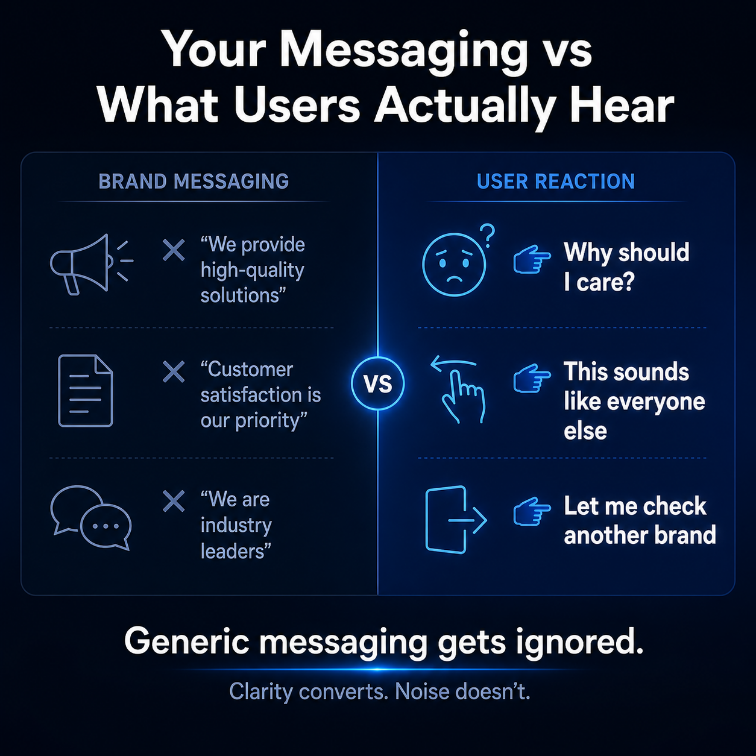
Very few recognise that they have a messaging problem.
Because messaging is not about what you say.
It’s about what the user understands – instantly.
And right now, most websites and ads sound like this:
- “We deliver high-quality solutions”
- “Customer satisfaction is our priority”
- “We are industry leaders”
Translation for the user:
👉 “I’ve heard this before. I’m leaving.”
Why Generic Messaging Fails Every Time
Users today are exposed to hundreds of brands every day.
They scroll fast. They decide faster.
So, when your message looks like everyone else’s, your brain does something simple:
👉 It ignores it.
Not because your product is bad.
But because nothing stands out.
This is the paradox of modern marketing:
The more you try to sound “professional,” the more you start sounding like everyone else.
The Gap Between Brand and User
Here’s another uncomfortable truth.
Most brands talk about:
- features
- services
- offerings
Users care about:
- outcomes
- problems solved
- benefits they feel
For example:
❌ “We offer advanced digital marketing solutions”
✅ “We help you turn website visitors into paying customers”
One describes the brand. The other speaks to the user.
And only one converts.
The Attention Window Is Brutally Small
You don’t have minutes to convince someone.
You have seconds.
When a user lands on your page or sees your ad, they subconsciously ask:
- “Is this relevant to me?”
- “Do they understand what I need?”
- “Is this worth my time?”
If your message doesn’t answer these immediately,
they don’t scroll further. They just leave.
Where Messaging Breaks in Real Campaigns
Let’s connect this to the actual marketing flow.
- Your ad promises one thing
- Your landing page says something else
- Your product page adds more confusion
This creates friction.
And friction kills conversions faster than bad design.
👉 This is where alignment between ads, content and landing pages becomes critical.
What Strong Messaging Actually Looks Like
Effective messaging does a few things really well:
- It is clear, not clever.
- It speaks to a specific audience, not everyone.
- It highlights value quickly.
- It reduces hesitation.
- It builds a connection.
And most importantly:
👉 It makes the user feel, “This is exactly what I was looking for.”
The Fix: Speak Like a Human, Not a Brochure
The easiest way to improve messaging is also the hardest for most brands.
Stop writing like a company.
Start communicating like a person.
- Use real language
- Address real problems
- Show real outcomes
Because users don’t convert when they’re impressed.
👉 They convert when they relate.
What This Means Going Forward
Even the best traffic and the fastest website won’t help if your message doesn’t land.
Because marketing is not just about being seen.
It’s about being understood.
👉 This becomes even more important as search evolves. Today, platforms are shifting toward intent-driven queries and conversational answers, moving from traditional SEO to AEO, where understanding user intent matters more than keywords.
At the same time, the rise of AI-driven interactions means users are increasingly relying on prompt-based search and AI queries to get precise, contextual answers instead of browsing endlessly.
5. The Data Illusion: Tracking Without Understanding
(Where dashboards look impressive… but decisions don’t improve)
By this point, most brands have accepted one thing:
👉 “We need data.”
So, they install everything.
- Google Analytics
- Meta Pixel
- Conversion tracking
- Heatmaps
- CRM dashboards
Suddenly, there are charts everywhere.
Traffic graphs. Funnel drop-offs. Engagement metrics.
It looks… sophisticated.
But here’s the uncomfortable reality:
👉 Most brands are data-rich and insight-poor.
The Problem: You’re Measuring Everything… Except What Matters
Open a typical analytics dashboard, and you’ll see:
- sessions
- page views
- bounce rate
- average session duration
Useful? Yes.
Actionable? Not always.
Because none of these directly answer the only question that matters:
👉 “What is actually driving revenue?”
The Gap Between Data and Decisions
Let’s break this down.
A brand sees:
- High traffic → “Good”
- Low bounce rate → “Also good”
- Decent engagement → “Even better”
But sales haven’t increased.
So what happened?
👉 The data was observed… but never interpreted.
The Attribution Mess Nobody Talks About
Here’s where things get messy.
A user might:
- discover you on Instagram
- Google your brand later
- click a search result
- return through a remarketing ad
- and finally convert
Now tell me – which channel gets the credit?
- Instagram?
- Google Search?
- Paid Ads?
Most systems will assign credit to the last click.
Which means:
👉 You’re making decisions based on incomplete truth.
And that leads to:
- cutting the wrong campaigns
- increasing spend in the wrong channels
- and misjudging what actually works
The Dashboard Trap
There’s also a psychological problem.
Dashboards make us feel in control.
You open a report, see numbers moving and think:
👉 “We’re on top of this.”
But tracking is not the same as understanding.
Without context, data becomes noise.
The Real Issue: No Funnel Visibility
Most brands track channels.
Very few track journeys.
They know:
- how many people came
- where they came from
But they don’t know:
- where users drop off
- why they hesitate
- what triggers conversion
- what causes abandonment
This is the difference between:
👉 channel metrics
and
👉 funnel intelligence
And only one of these helps you grow.
What Smart Brands Do Differently
High-performing brands don’t just collect data.
They structure it.
They:
- map the full funnel (traffic → engagement → conversion)
- track key actions (clicks, scrolls, add-to-cart, drop-offs)
- connect platforms (ads + website + CRM)
- analyse patterns, not isolated numbers
Most importantly:
👉 They use data to make decisions, not just reports.
The Shift: From Reporting to Insight
The real goal of analytics is not to “know what happened.”
It’s to understand:
- what’s working
- what’s not
- and what to do next
Because without that, data becomes:
👉 expensive decoration.
What This Means Going Forward
If your marketing decisions are still based on:
- last-click reports
- surface-level metrics
- or gut feeling
…then you’re not using data.
You’re just looking at it.
👉 This is where the next wave of marketing is heading – toward systems that don’t just collect data but interpret it, as seen in AI-driven marketing trends shaping digital strategies today.
The Bottom Line
Tracking is easy.
Understanding is hard.
And growth only comes from the second.
6. The Campaign Mindset: Why Short-Term Thinking Kills Long-Term Growth
(Or: why every “new campaign” feels like starting from zero)
Let’s talk about one of the most common and least discussed problems in digital marketing.
The obsession with campaigns.
Every month, there’s something new:
- A festive sale campaign
- A product launch campaign
- A “this time we’ll scale” campaign
New creatives. New budgets. New expectations.
And for a few days, things look promising.
Traffic spikes. Engagement goes up. Maybe even some sales.
Then it drops.
And the response?
👉 “Let’s launch another campaign.”
The Problem: Campaigns Create Activity, Not Momentum
Campaigns are not the problem.
The mindset around them is.
Because most brands treat marketing like a series of isolated bursts instead of a connected system.
Each campaign is:
- planned from scratch
- executed in isolation
- measured independently
And once it’s done, everything resets.
👉 No learning compounds
👉 No system improves
👉 No long-term growth builds
It’s like going to the gym once a month and expecting results because that one workout felt intense.
Why This Approach Feels Good (But Fails)
Short-term campaigns are addictive.
They give:
- quick results
- visible spikes
- something to report
And in a world where everyone wants instant outcomes, that feels like progress.
But here’s the catch:
👉 Spikes are not growth.
👉 Consistency is.
The Hidden Cost of Constant Reset
Every time you launch a new campaign without a system behind it, you:
- relearn your audience
- retest your messaging
- rebuild your funnel
- and re-spend to get the same insights
In other words:
👉 You pay for the same learning… again and again.
What Actually Drives Growth: Compounding Systems
Now compare that with how high-performing brands operate.
They don’t rely on campaigns alone.
They build systems where:
- every campaign feeds data into the next
- messaging evolves based on insights
- funnels improve over time
- and performance compounds
So instead of:
Campaign → spike → drop → repeat
They create:
System → optimisation → learning → growth
The Difference in Real Terms
Let’s simplify this.
Campaign-driven brand:
- Runs ads for 30 days
- Sees results
- Stops
- Starts again next month
System-driven brand:
- Runs continuous campaigns
- Tracks behaviour
- Improves funnel
- Retargets users
- builds an audience over time
After 6 months, both have spent money.
But only one has built:
- better conversion rates
- stronger audience data
- lower acquisition cost
- predictable growth
The Role of Retention (The Most Ignored Lever)
Here’s where the campaign mindset completely breaks.
Most campaigns focus on:
👉 getting new customers
Very few focus on:
👉 bringing them back
And that’s a massive mistake.
Because:
- repeat customers convert faster
- cost less to acquire
- and increase lifetime value
Without retention systems like:
- remarketing
- email flows
- CRM-driven engagement
…every campaign starts from zero.
The Shift: From Campaigns to Continuity
And, if you look closely, most of these shifts align with modern digital marketing strategies that focus on long-term systems instead of short-term campaigns.
This doesn’t mean campaigns are useless.
It means they should plug into a larger system.
Where:
- traffic is captured
- users are nurtured
- data is reused
- and performance improves over time
Because real growth doesn’t come from doing more campaigns.
👉 It comes from making each one smarter than the last.
What This Means Going Forward
If your marketing still looks like:
- bursts of activity
- followed by silence
- followed by another push
…you’re not building growth.
You’re restarting it.
👉 The brands that win in 2026 are not the ones with the most campaigns.
They’re the ones with the strongest systems behind them.
The Bottom Line
Campaigns create noise. Systems create results.
7. The Fix: Building a Connected Digital Marketing System
(Where everything finally starts making sense)
By now, the pattern is clear.
It’s not your ads.
It’s not your creatives.
It’s not even your budget.
👉 It’s the lack of a connected system.
Because when marketing fails, it rarely fails in isolation.
It fails in the gaps – between traffic and experience, between clicks and conversions, between data and decisions.
So, the real question is not: “Which channel should we optimise next?”
It’s: “How do we make everything work together?”
The Shift That Changes Everything
The moment brands stop thinking in channels and start thinking in systems, things change.
Instead of:
- SEO vs Ads
- Social vs Website
- Traffic vs Conversion
You start building a continuous flow:
👉 Traffic → Experience → Conversion → Retention → Data → Optimisation
Each part feeds the next.
Nothing operates alone.
That’s what turns marketing from effort into momentum.
The System, Broken Down
Let’s simplify what a connected digital marketing system actually looks like.
1. Traffic Layer – Attracting the Right Users
This is where discovery happens.
- SEO brings high-intent users
- Google Ads captures demand
- Social media builds awareness and interest
But here’s the key:
👉 All traffic must be intent-aligned
That means:
- Your keywords match your offer
- Your ads match your landing pages
- Your content matches your audience
Because traffic without intent is just noise.
2. Experience Layer – What Happens After the Click
This is where most brands lose the game.
Your website is not a destination.
It’s a decision environment.
It must:
- load fast
- communicate clearly
- guide users
- remove friction
👉 This is where high-performance web development and UX design directly impact revenue.
3. Conversion Layer – Turning Interest into Action
Now that users are engaged, the system must:
- guide them toward a clear next step
- reduce hesitation
- build trust
This includes:
- strong CTAs
- clean funnels
- persuasive messaging
- checkout optimisation
Because traffic means nothing if it doesn’t convert.
4. Retention Layer – The Most Underrated Growth Lever
Most brands stop at conversion.
Smart brands build beyond it.
Retention includes:
- remarketing campaigns
- email flows
- CRM-driven engagement
- repeat purchase strategies
👉 This is where profitability improves.
Because acquiring a customer is expensive.
Keeping one is not.
5. Data Layer – The Brain of the System
This is what connects everything.
A strong system tracks:
- user journeys
- drop-offs
- behaviour patterns
- conversion triggers
And then uses that data to:
- improve targeting
- refine messaging
- optimise funnels
👉 Data is not for reporting.
👉 It’s for decision-making.
What This Looks Like in Reality
When all these layers are connected:
- Your ads bring the right people
- Your website converts them efficiently
- Your system brings them back
- Your data makes each cycle better
So instead of: spending more to grow
You start: growing because your system improves
The Big Difference
Let’s make it simple.
Disconnected marketing:
- campaigns feel random
- results fluctuate
- costs keep rising
Connected system:
- performance improves over time
- decisions get smarter
- growth becomes predictable
Where Most Brands Get It Wrong
They try to fix one part at a time.
- “Let’s improve ads”
- “Let’s redesign the website”
- “Let’s increase traffic”
But without fixing the connections, nothing changes meaningfully.
👉 Because optimisation in isolation doesn’t scale.
The Bottom Line
Digital marketing doesn’t need more effort.
It needs better integration.
Because when everything works together:
- traffic becomes valuable
- experience becomes persuasive
- data becomes actionable
- and growth becomes consistent
Final Takeaway
If there’s one idea to take from this entire blog, it’s this:
👉 Digital marketing doesn’t fail because you’re doing too little.
👉 It fails because what you’re doing isn’t connected.
Fix the system, and everything else starts working.
Closing Line
You don’t need more campaigns.
You don’t need more traffic.
👉 You need a system that makes them work.